Institute of Human Origins

Hot Topics—News + Events
Gala Dinner and Symposium wrap up Year of Celebration
Thank you to all of our sponsors, speakers, and guests who attended the Gala Dinner and Symposium. A few photos of the event can be found at the Arizona Red Book website.
Founding Director Don Johanson was featured speaker at IHO's 30th Anniversary Gala Dinner on April 26, 2012.
Notes from the Field: A Year in the Field Comes to an End

Samantha Russak is on her way home now after spending a year in Tanzania, and her last blog entry reflects the importance of living in and learning about new cultures, new countries, and new communities. It also reminds us to be thankful for the abundance that we are privileged to live in here in the U.S. and the positive impact that we strive to bring along with us as we partner with people and organizations in countries in Africa and elsewhere. Sam has been a tremendous example of hard work, positive attitude, and excellent ambassadorship for IHO. Thank you to Samantha! Click here for the link
Sam Russak with Jane Goodall at the Jane Goodall Institute in Gombe.
ASU's Research Matters Highlights IHO in New Video
ASU President Crow Applauded for Defense of Anthropology
Slate.com article by Michael Crow:
http://www.slate.com/articles/news_and_politics/politics/2011/10/michael_m_crow_president_of_arizona_state_university_explains_wh.html
The Economist: http://www.economist.com/blogs/democracyinamerica/2011/10/education-policy
Curtis Marean Interview Featured for "Science Lives" at LiveScience.com
In a video interview, Curtis Marean answers some basic, but revealing, questions about the nature of being of scientist—his inspiration, the societal benefits of his research, the biggest influences on his professional life, and what his first “experiment” was as a child.
The website LiveScience.com has a series called “Science Lives,” which features interviews with prominent researchers—from engineers to historians to a diversity of scientists. This week, “Science Lives” features an interview with Curtis Marean, Institute of Human Origins Associate Director and professor, School of Human Evolution and Social Change. This “Science Lives” interview was provided to Live Science in partnership with the National Science Foundation.
The interview can also be seen at http://www.livescience.com/16431-human-origins-marean-nsf-sl.html.
From Field to Lab: IHO Museum Exhibition Covers 30 Years of Research
The exhibition opened September 8 with a greeting “drummed” by an ASU African drumming student group, which welcomed over 200 people to a ribbon cutting ceremony by institute director William Kimbel and founding director Don Johanson and School of Human Evolution and Social Change executive director Alexandra Brewis Slade. The exhibition will also host over 120 fifth and sixth graders this week with presentations by IHO-affiliated PhD students Halszka Glowaka, Neysa Grider-Potter, Lynn Lucas, Terry Ritzman, Amy Shapiro. With seven computers or DVD players and seven iPads and life-like vingettes of Hadar and a lab, the experience is truly an interactive immersion in IHO research and history. Read more at ASU News.
Untangling the Human Family Tree One Branch at a Time
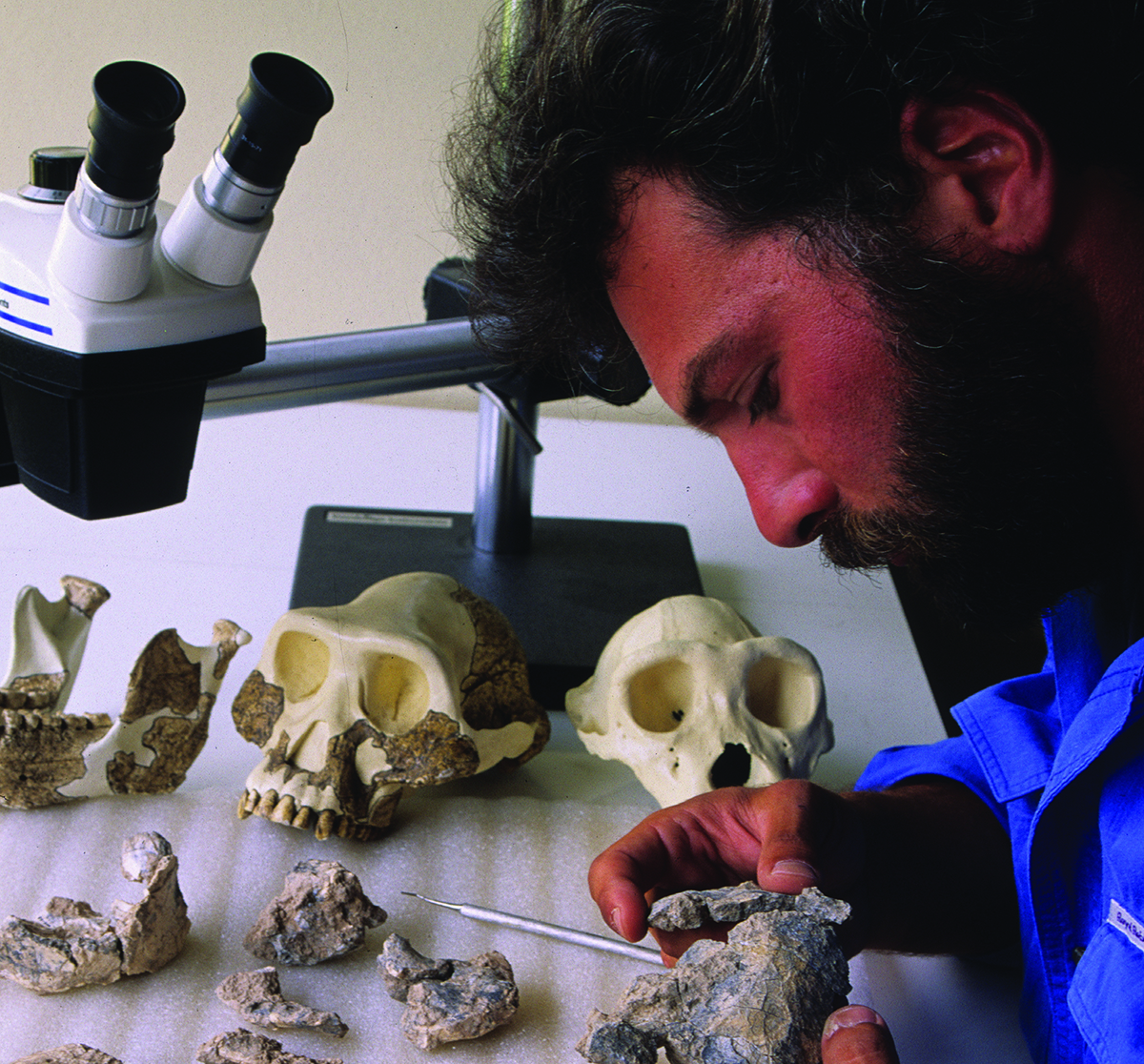
(September 20, 2011) ASU graduate Brian Villmoare, now with The George Washington University and University College London, and Institute of Human Origins Director William Kimbel are using new technologies to solve classic evolutionary puzzles. CT scans of the skulls of five different species of Australopithecus reveal unseen details hidden within the bone structure.
Read more at ASU News
BECOMING HUMAN: 30 Years of Research and Discovery
Museum Exhibition Continues!
Museum Exhibition: September 8 through December 16.
Museum of Anthropology, School of Human Evolution and Social Change, Tempe Campus
This beautifully designed and executed exhibition tells the story of the institute's 30-year impact on anthropology and understanding the human career from the discovery of "Lucy" by Donald Johanson in 1974 to today's engaging research into how the human race may have survived in very small numbers in caves at the tip of South Africa.
For museum hours, guided tours, and special events in association with this exhibition, go to http://asuma.asu.edu, email anthro.museum@asu.edu, or call 480.965.6224.
The exhibition is cosponosored by the Institute of Human Origins, Museum of Anthropology, and School of Human Evolution and Social Change.
Museum exhibition website: iho.asu.edu/museum_exhibition
MORE NEWS
IHO Internationally Affiliated Faculty Harold Dibble and
PhD Student Emily Hallett-Desguez Featured on
National Geographic Channel
A National Geographic documentary features Harold Dibble and his research team as they dig fossil bones in a Moroccan cave and analyze how that ancient person might have looked. The show, "World's Oldest Child" aired on Thursday, June 16. Check the NatGeo Channel in the future for additional showings.
• Read about the show and research at http://asunews.asu.edu/20110615_NGSDibble
• Philadelphia Inquirer article http://www.philly.com/philly/news/pennsylvania/123980544.html
• UPI article http://bit.ly/lqSIhy

Institute of Human Origins' Associate Director Curtis Marean is named one of ASU's Outstanding Professors of 2011
(April 13, 2011) Curtis Marean was one of only nine professors to be recognized for this year's 2011 Faculty Achievement Awards for Defining Edge Research in Social Science. The awards are made for a specific contribution appearing in the last 10 years that meets the highest standards of the discipline or profession. The contributions significantly change their professions in research, creative activities and undergraduate instruction, placing the achievements among the highest at the university.
After receiving input from the faculty, nominations for the Faculty Achievement Awards are made by deans and reviewed by panels of Regents’ and President’s Professors. Read the full article here.
IHO Associate Professor Gary Schwartz received the same recognition in 2010 for Defining Edge Science.
Institute of Human Origins Celebrates 30 Years of Research and Discovery
(March 9, 2011) What began as an institute for the study of human origins is now a research center engaged in leading-edge science and discovery of how we became human. To celebrate the institute’s 30th anniversary, a full year of events has been planned to bring renowned scientists and experts in human origins to ASU.
Read the full story at http://asunews.asu.edu/20110309_IHO30th.
Published in the journal Science
3.2 million-year-old fossil foot bone supports humanlike bipedalism in Lucy’s species, Australopithecus afarensis
(February 11, 2011) A fossilized foot bone recovered from Hadar, Ethiopia, shows that by 3.2 million years ago human ancestors walked bipedally with a modern human-like foot, a report that appears Feb. 11 in the journal Science, concludes. The fossil, a fourth metatarsal, or midfoot bone, indicates that a permanently arched foot was present in the species Australopithecus afarensis, according to the report authors, Carol Ward of the University of Missouri, together with William Kimbel and Donald Johanson, of Arizona State University’s Institute of Human Origins.
See the full story on the ASU News website: http://asunews.asu.edu/20110211_twofeet
>ASU Institute of Human Origins and "Lucy" are now on Facebook and Twitter! Keep track of events, lectures, breaking news in anthropology, and find out where in the world our faculty are traveling! "Like" us on Facebook or "Follow" us on Twitter.
+More current news (2011)
Events and Special Tours
Where in the World is Don Johanson?
TMCC Dandini Campus, 7000 Dandini Blvd/Red Mountain building, room 324. Tickets must be purchased in advance at www.tmcc.edu/dss. Cost: $10 general admission, $5 student admission. More info at 775.336.4555.
+more Events + Lectures
Of Interest
>Becoming Human, IHO's Webby award-winning website, brings together interactive multimedia, research, and
scholarship to promote greater understanding of the course of human evolution. For all ages.